
Strategy #14: The 3 Down Daily Pullback Strategy
A simple, high-win-rate system that profits from market overreactions. No complexity, just price action and proven results.

What if I told you the most profitable trades often come from the simplest setups?
No complex indicators. No machine learning algorithms. No scanning through thousands of stocks.
Just pure price action and a straightforward concept.
Trading isn't about being smarter than everyone else. It’s about being consistent, disciplined, and exploiting market behaviours, in this case: overreaction.
Over the past years, I’ve tested this strategy across multiple market regimes, different instruments, various parameter sets, and multiple robustness checks.
Since 2024, I decided to put it in my live portfolio with a small size to let it trade together with my other strategies in my portfolio.
This strategy has a slightly lower MAR (CAGR/Max Drawdown ratio) than simply buying and holding the Nasdaq 100 if you compare it for the last 2 years, but it’s 6 times more capital efficient thanks to its low time in the market.
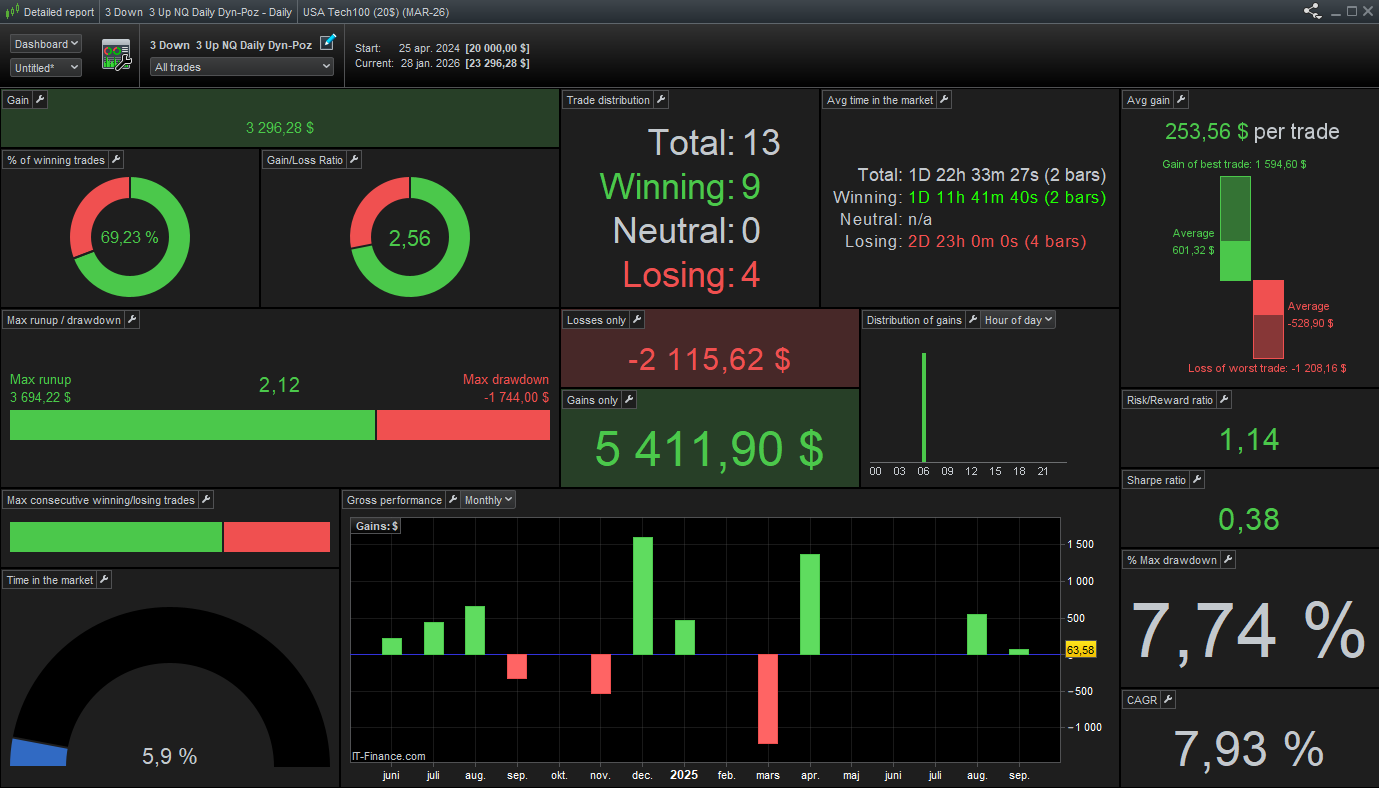
Basically, you’re only in the market a fraction of the time, freeing up your capital to work elsewhere while still capturing significant market gains. Yes, over the past 2 years this strategy hasn’t outperformed the index in absolute returns but when you adjust for time in market, it crushes buy-and-hold.
Track This Strategy’s Real Performance
Want to see how this strategy (and all my others) are actually performing?
I’ve built a public tracker that shows the real returns of every strategy I’ve published.
👉 View the strategy tracker here
What you’ll see:
Year-to-date returns for all 10+ strategies
Total returns since published
Maximum drawdown per strategy
Win rates & MAR ratios
Live vs. paper trading status
Real numbers with correct spreads and commissions
No cherry-picking. No hiding the strategies that didn’t work. Updated monthly.
Most “Backtests” Are Worthless
Here’s an uncomfortable truth about trading strategy development...
Most backtests you see online are garbage.
They’re optimized on a single instrument, with cherry-picked parameters, over a convenient time period that makes the equity curve look beautiful. Why?
Overfitting: The strategy was designed to fit the past, not predict the future.
Lack of Robustness Testing: No one bothered to check if it works with slightly different parameters.
Single Market Bias: It only works on one specific instrument during one specific market regime.
No Out-of-Sample Validation: Everything was “in-sample,” meaning the strategy has never seen truly unseen data.
Hidden Look-Ahead Bias: Subtle coding errors that use future information.
That’s why I obsess over simplicity, because in my opinion it is the easiest way to create a robust strategy.
For this strategy, I didn’t just run a backtest and call it done.
I’ve tested it with several robustness tests:
Across different instruments (NQ, ES, DOW)
With varying parameter ranges to ensure edge persists beyond specific values
Through multiple market regimes (bull markets, bear markets, sideways chop)
On both CFD and futures data to validate execution assumptions
With realistic transaction costs (spread, slippage, commissions)
Against random entry/exit variations to confirm the rules actually matter
Now, let me show you some of these tests.
Let’s start with watching how this strategy looks like on other markets and types of data (CFDs & Futures). In my opinion it doesn’t make sense for a Nasdaq strategy to perform as good on other markets but it should look roughly similar in performance, the most important part I am looking for is if a strategy completely fails on another similar index, that is a red flag for me. All these backtests include a 2 point spread.


As you can see here the strategy works fine on SP500 but is pretty bad on the Dow Jones, however it’s still profitable and that is a pretty strong sign.


Parameter Sensitivity Tests
Another robustness I like to do on all my strategies before I even think about running them live is a parameter sensitivity test.
This strategy has two key parameters, I will show you the exact parameters in the end of the article together with the full code.
Here are the parameter sensitivity test for the first parameter:


As you can see there is a smooth curve in the performance downgrade and not a sharp cliff which means it’s likely not overfit, when something is overfit the parameter usually has drastically lower performance in both directions, here the max dd gets worse together with increased gains.
The second parameter is very important because it is the main filter, here I have also made one backtest with the parameter 10% down in value and one 10% up to show how robust the parameter is even if the value changes as much as 10% in any direction in the future.


Random Exit Criteria
The last test I want to show you is with another exit, I will compare the exit I use with another classic mean-reversion exit to see how much the exit matters.
Here is the comparison on Nasdaq100 Futures:
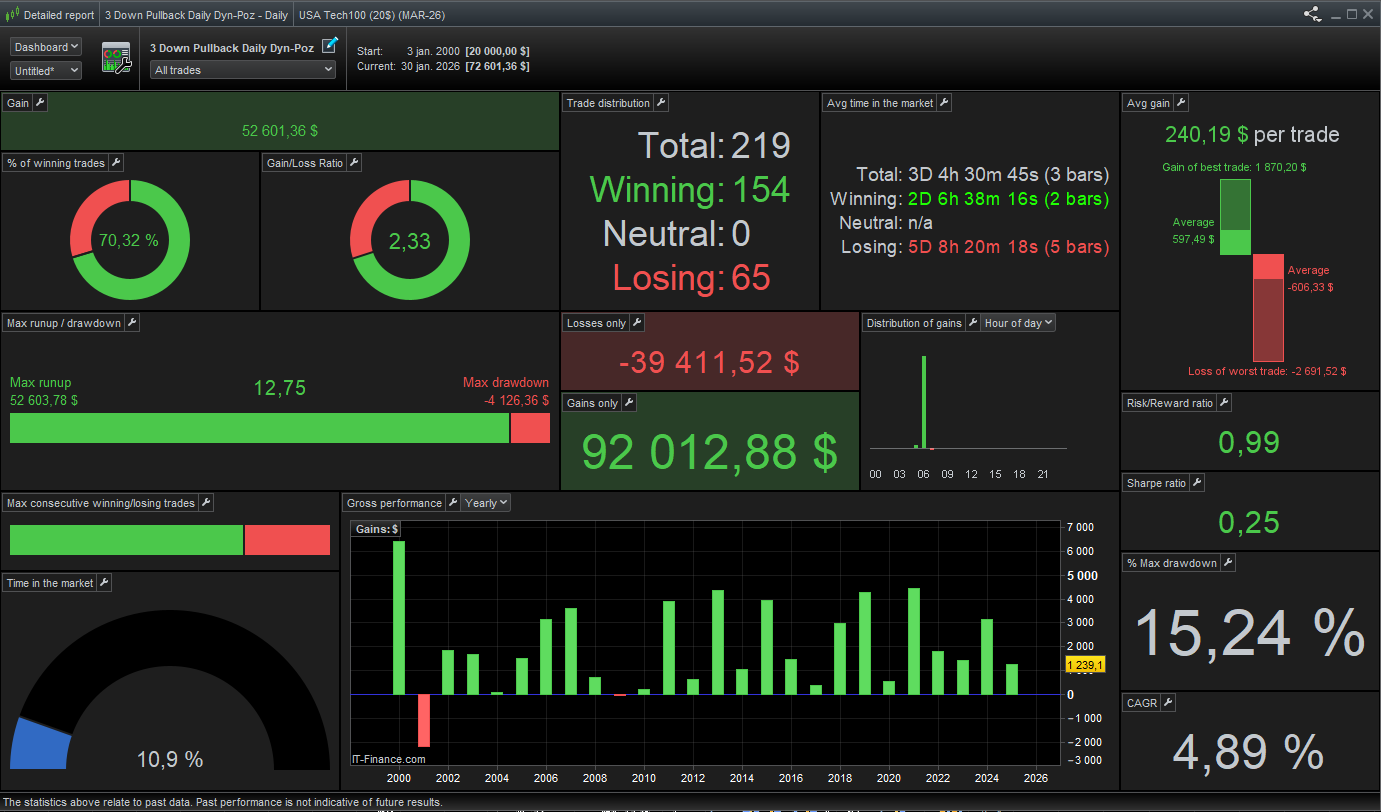
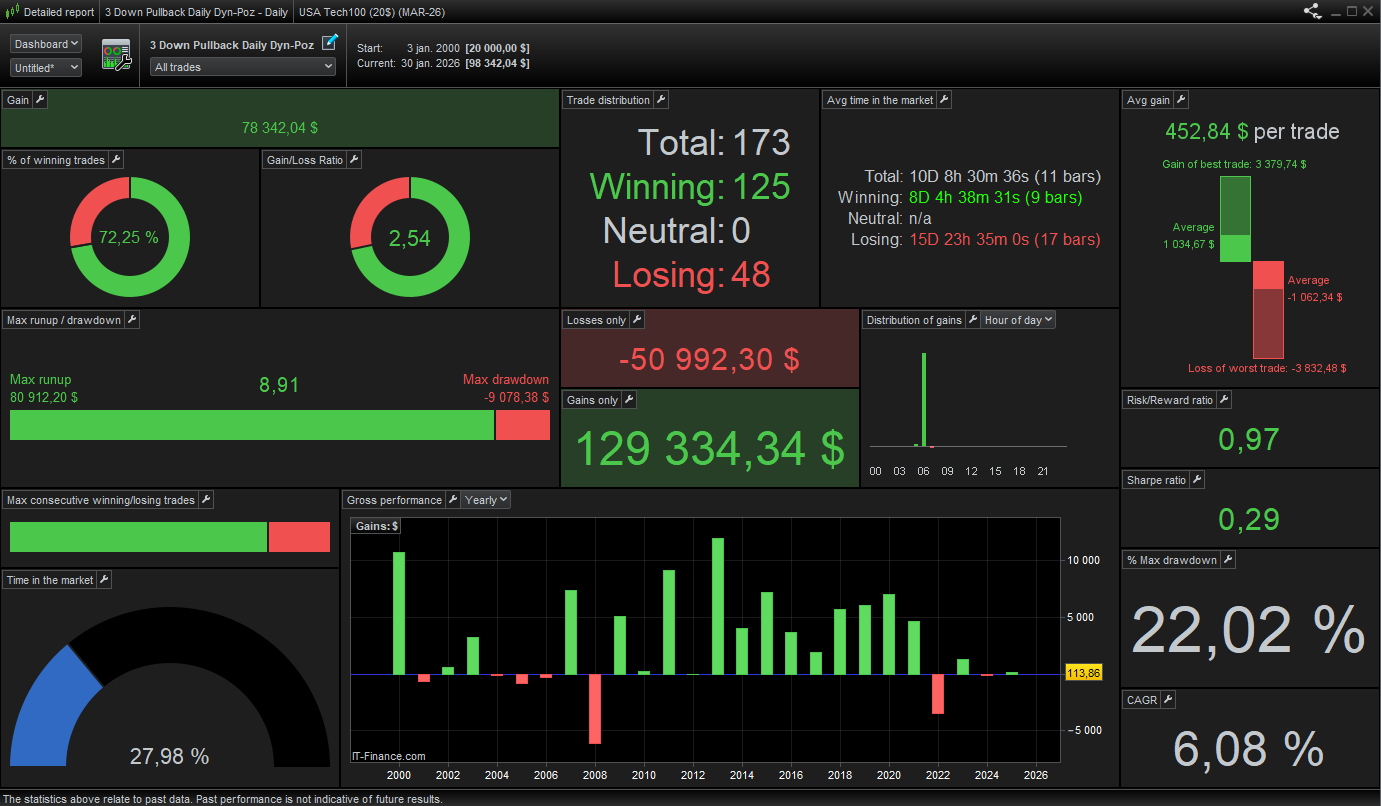
Backtest Performance 2000-2026


Full Code & Detailed Walk-Through
Below is the complete ProRealTime code, followed by a plain-English walkthrough of the whole code and each parameter so that you easily can translate this strategy to any trading platform.